

Dr. Peterson made the same claim in almost every single one of his 36 public interviews plus public appearances, in his speech in front of the Sul Ross statue at the AAUP’s Academic Freedom Protest, and again at his so-called “banned lecture” publicity stunt at the Memorial Student Center, that:
“Plato’s view was that there are more than two genders, at least three, and Plato also wrote that same sex relationships are fully normal, something natural, nothing problematic.”
Peterson argues that this is why the Regents wanted Plato banned, because Plato is “woke.”
The Aggie Standard is a reader-supported publication. To receive new posts and support my work, consider becoming a free or paid subscriber.
Here’s the recording from his Banned Lecture publicity stunt at the MSC (video credit to MOVETX, the liberal org that posted it on social media)
During this lecture, we get a peek at what Peterson’s classes look like.
If he talks like this at a recorded, publicized lecture, imagine what he teaches behind closed doors.
“It seems reasonable to conclude that Plato, or at least the view he was discussing, holds that homosexuality is fully natural. It’s not unnatural to be homosexual. It’s not unnatural to perhaps be non-binary. It’s all fine.” (00:24:34-00:24:59)
Later in the lecture: “Plato does not seem to have been very bothered about this. He seems to be fully okay, fully chill about this. He wasn’t stressed out about being more than two biological sexes or genders.” (00:39:01-00:39:20)
And during the student discussion: “The mere fact that Plato brings this up seems to suggest that he was at least well aware of the variation in the world, there being more than, at least more than, perhaps more than two genders.” (00:33:02-00:33:09)
But there’s a problem. He’s got a Doctorate of Philosophy, he was a tenured professor at A&M, yet it seems he never actually really read the primary sources where plenty of evidence directly contradicts him.
All despite claiming that parents should not be concerned about indoctrination in college and that they should let the “experts” like him (supposedly), do the talking.
So much for the lie that he “is not advocating any ideology” like Peterson and FIRE repeated numerous times.
Plato left us a warning precisely about what Peterson did
The Laws is Plato’s final work. It’s a long, practical dialogue about how a just society should be governed. In it (636c-d), Plato condemns the Cretans for inventing a story about Zeus engaging in same-sex acts. First he states his position plainly, saying that it is: “contrary to nature when male mates with male or female with female, and that those first guilty of such enormities were impelled by their slavery to pleasure.”
Then he identifies what the Cretans actually did:
The scheme is simple: take a revered authority figure, invent a convenient story about him, and present it as an endorsement of what you already want to do. Sanctify your desires by association.
This is precisely what Professor Peterson did with Plato.
What Plato actually said in the Symposium
Peterson's entire argument rests on a single speech from the Symposium, which is the transcription of a dinner party where several guests drink wine and give speeches about love, each one getting closer to the truth than the last. Peterson is quoting the comic playwright Aristophanes, who is not a philosopher, who spins a myth about human origins. In his telling, humans were originally three types: male, female, and androgynous, before Zeus split them apart. Peterson presents this as Plato's considered view on gender.
He does not mention what the passage actually says about that third category. The Harvard University Press translation is unambiguous:
"For androgynous was then a unity in form no less than name, composed of both sexes and sharing equally in male and female; whereas now it has come to be merely a name of reproach."
Within the very passage Peterson cites, "androgynous" survives in Greek only as an insult. He did not tell his students at his “Banned Lecture” publicity stunt about this.
The dinner party ends with Socrates speaking last, delivering the highest account of love through a philosopher named Diotima: that love, properly understood, is the soul's ascent away from physical desire toward truth and beauty themselves. Aristophanes' myth is not Plato's conclusion. It is what Plato's philosophy moves beyond. Peterson took one of the most basic speeches at the table and called it the point of the whole evening.
What Plato actually said about Gender
The Timaeus is Plato’s account of how the universe and human beings were made. It’s his cosmology, his serious statement about the nature of reality. In it, he states directly:
“Human nature is two-fold” (Timaeus 42a–b)
Meaning male and female only, not “two genders, at least three” like Peterson claimed. And no mention at all of the word “non-binary”.
He goes further. In the same dialogue, Plato says that women are men who “were cowards or led unrighteous lives” in a previous incarnation, reborn in female form (Timaeus 90e). Whatever one makes of that claim, it is not really a “woke” view of gender like Peterson would have us believe.
In the Republic, his famous dialogue on justice and the ideal city, Plato asks whether women should serve as Guardians alongside men. The entire argument is framed around what he calls the enantion (ἐναντίον): the “opposite” natures of male and female.
So Plato, in his primary sources, actually believed that human nature is “twofold” and “opposite”, which is directly contradictory to Peterson’s claims of gender ideology.
What Plato actually said about same-sex acts
Across multiple dialogues, Plato condemns homosexual intercourse explicitly. These are not translation choices or matters of interpretation; they are the words he chose, and they are surprisingly unambiguous:
Tolmema (Laws 636c): A daring crime, a shameless outrage. “Those first guilty of such enormities were impelled by their slavery to pleasure.”
Para physin (Laws 636c): Contrary to nature. “It is contrary to nature when male mates with male or female with female.”
Anosion (Laws 838b): Unholy, impious. Plato compares same-sex acts to incest, arguing both should be treated as religious taboo.
Aischron (Laws 841b): Shameful, disgraceful. The lawgiver must build social stigma around these acts to suppress the desire. “The feeling of shame which these things naturally inspire still has power enough to prevent the acts which they call shameful.”
Manikon (Republic III, 403b): Mad, insane. Socrates ruled out same-sex sexual contact as incompatible with the philosophical soul.
Hibris: Hubris, wanton outrage. In the Chariot Allegory of the Phaedrus (253c–254e), a passage Peterson himself quoted in his banned lecture, Plato describes the soul as a charioteer driving two horses: one noble, one wild. The wild horse is sexual appetite. The charioteer’s entire task is to restrain it. Peterson quoted this allegory and told his audience it supports acceptance of physical love when it actually argues the opposite.
In contrast to all this, Plato uses the Greek word “sophrosyne” (Republic IV, 430e–432a) to refer to the virtue of temperance, self-control, the harmonious ordering of the soul where reason governs appetite. It is one of his four cardinal virtues. In both the Republic and Phaedrus, the well-ordered soul is one where sexual desire is restrained by reason, not indulged. The Phaedrus describes the “scala amoris,” a ladder of love where erotic attraction serves as a stepping stone toward intellectual and spiritual ascent, not physical consummation. The journey is upward, away from the body, toward contemplation of eternal Beauty itself.
Socrates, Plato, and Aristotle all condemned homosexual acts
Peterson frames his argument as an interpretation of Plato specifically. But the philosophical tradition he is misreading, and that he should know, as a tenured professor with a Doctorate in Philosophy, is far larger than one dialogue.
Socrates, Plato, and Aristotle, the three pillars of classical philosophy, held identical views on physical same-sex acts. Historians like K.J. Dover and legal philosophers like John Finnis demonstrate a strict consensus among the Big Three that divided romantic/intellectual attraction (Platonic love, which they praised) from physical sexual acts (which they generally rejected). Note that both Aristotle and Socrates did marry a woman, but did not engage in same sex acts, with Socrates explicitly rejecting an advance from the strongest and most intelligent Athenian youth called Alcibiades.
Socrates’ views survive through two sources: Plato and the historian Xenophon, who each wrote their own account of a dinner party called the Symposium. In Plato’s version, Socrates rejects the physical advances of Alcibiades, which we will return to. In Xenophon’s version, Socrates goes further and states the case directly: he argues that a relationship built on physical lust destroys character, while a chaste relationship built on virtue improves the soul. K.J. Dover, the historian most sympathetic to ancient Greek homosexuality, concluded from both accounts that “the Socrates of Plato and Xenophon condemned homosexual copulation as such.”
Aristotle approached the question differently, not through law or allegory, but through biology and morality. In Book VII of the Nicomachean Ethics (1148b), he classified same-sex intercourse among behaviors that are “not naturally pleasant,” arising either from physical disease or from habits formed through abuse and trauma. His framework was teleological (Greek telos = purpose + logia = study): because he viewed the natural purpose of sex as procreation, any act that structurally cannot fulfill that purpose is, by definition, a departure from natural order. “Some things are pleasant by nature,” he writes, “and of these some are so without qualification, and others are so with reference to particular classes either of animals or of men; while others are not pleasant by nature, but some of them become so by reason of deformity, and others through habit.” Same-sex intercourse falls in the latter category, not natural, but habituated.
Socrates rejected one of his students’ sexual advances
If the texts are not enough, consider the example in Socrates’ own life.
In the Symposium, a young Athenian man famous for his physical prowess, wealth, and status named Alcibiades, gives a speech where he describes how he once tried to seduce the philosopher (Socrates) by having dinner and wine with him. Later at night, he slipped into his bed, under his cloak, and held him close, trying to initiate it.
But Socrates did absolutely nothing. Alcibiades recounts that Socrates had rejected his advances totally and treated him “no differently than if I had slept with my father or an older brother.”
Alcibiades was humiliated but also transformed. He admitted he had never met a man with such extraordinary self-mastery. This is the virtue Plato actually celebrated.
It’s not the first time
This Cretan myth-manufacturing to normalize abnormal things has been going on for a while now. In 1993, philosopher Martha Nussbaum made identical claims about Aristophanes before the Colorado Supreme Court in Evans v. Romer. She was systematically refuted by legal philosopher John Finnis.1 When I was researching this, I saw Dr. Robert George, the McCormick Professor of Jurisprudence at Princeton, who is one of the most eminent legal philosophers in the country, had also participated, so I decided to cold email him, expecting to never hear back. To my surprise, he responded within an hour, saying:
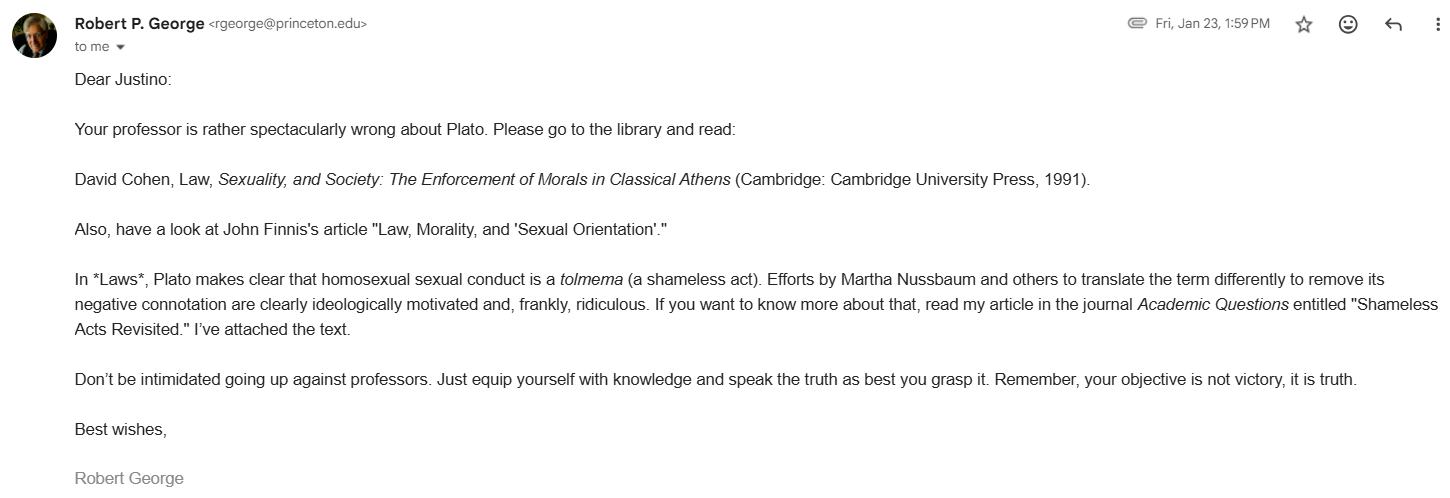
It's important to state this plainly: there are no legitimate grounds for debate on whether the great classical philosophers supported gender ideology and homosexuality. The facts are clear, as Dr. George outlines above: Peterson's interpretation is as good as revisionist history. It is a fringe theory.
K.J. Dover, a key historian most sympathetic to ancient Greek homosexuality, who concluded that "the Socrates of Plato and Xenophon condemned homosexual copulation as such." Gregory Vlastos, another crucial classical scholar, described Platonic love as involving erotic attraction but explicitly withholding physical acts, what he called "terminal gratifications." John Winkler, too, argued Plato's goal was to render same-sex desire "as unthinkable as incest,” according to Laws.
And Aristotle, Plato's greatest student, classified same-sex intercourse in Book VII of the Nicomachean Ethics among behaviors that are "not naturally pleasant,” arising either from disease or from habits formed through trauma, because any act structurally incapable of fulfilling the natural purpose of sex was, by his framework, a departure from natural order.
The Cretans among us
As a tenured professor at one of America’s greatest universities, an “expert” as he calls himself, and a doctor of philosophy, how can one deliver an entire lecture on Plato’s views on gender and homosexuality without once quoting the Laws or the Republic, or the many texts that directly contradict your claim?
The answer is that Peterson, like the Cretans and many other progressives today, are not genuinely interested in Plato’s views or in the Gods’, or in God’s. They are interested in using their name to justify their preconceived notions, to advance their political agenda, just like the Cretans that Plato condemns.
Peterson, in a classic leftist teacher maneuver, only presents selectively edited facts or parts of a story that align with his preconceived morality. Instead of presenting the full truth, the entire graph, the full picture, he chooses statistical outliers, exceptions to the rule, to mislead students, teachers, and voters.
This is a textbook example of the academic indoctrination that Texas voters want to address. It is due time to go on reforming it, because students deserve the truth, the full truth, and nothing but the truth, and it is only reality and not convenient lies that form and raise civilizations to greatness.
Would you let the Cretans teach your kids? I surely wouldn’t.
Thanks and Gig ‘em,
Justino Russell ‘26
Student, Founder, Editor
The Aggie Standard
Unfortunately, after the people of Colorado had exercised their democratic rights and voted against legal privileges for same-sex people via Amendment 2, the U.S. Supreme Court ruled 6–3 in Romer v. Evans (1996) that the referendum result was unconstitutional and struck it down.


