

Opinion: What's All This About Iran's Nukes?
Iran has been "weeks away" since the 90s. The bomb never showed up, but the war did.

Opinion: The views expressed in this article are the author’s and are published as commentary and analysis by The Aggie Standard. Responses and fruitful dialogue are welcome.
In his February 24, 2026 State of the Union address, before the war, President Trump warned that Iran is again “pursuing their sinister ambitions” to make a nuclear weapon as justification for his coming attack, despite saying the U.S. military “obliterated Iran’s nuclear weapons program” last June a few seconds before. He added that negotiations are contingent on the “secret words” from Iranian leadership: “We will never have a nuclear weapon.” But those of us paying attention saw that just hours before Trump’s speech, Iran’s Foreign Minister Abbas Araghchi posted on X,
“Our fundamental convictions are crystal clear: Iran will under no circumstances develop a nuclear weapon, neither will we Iranians ever forgo our right to harness the dividends of peaceful nuclear technology for our people,”
adding that their primary focus is on negotiations to address mutual concerns and interests.
Now, no serious person is saying we should have blindly trusted the Islamic Republic and called it a day, but we could have look at the record of what Iran has actually done since breaking ties with us in 1979, and compare that to the propaganda of claims from the U.S. officials who used the same justification for the current war in Iran. If you want the truth instead of the hawks’ talking points, we need to walk through the whole nuclear “crisis” from the beginning, because the evidence all points to a story that constantly reiterates that Iran has never tried to make nuclear bombs.
What the Intelligence Actually Said
In 2007, the U.S. intelligence community’s National Intelligence Estimate judged “with high confidence” that Iran halted its nuclear weapons program in 2003. That assessment landed like a rebuke to the Bush administration’s attempts to inflate the threat into a casus belli because if the bomb program had been stopped years earlier, then the “we have to act now” pitch collapses.
And it wasn’t just an American judgment either. Reporting on leaked intelligence cables indicated that Israel’s own intelligence services, the Mossad, reached a similar bottom line in 2012: that Iran had not begun to build a bomb.
In fact, American investigative journalist Gareth Porter wrote heavily on this in his book Manufactured Crisis: The Untold Story of the Iran Nuclear Scare, which argued that even the claims about a substantial pre-2003 weapons effort were oversold, relying on thin sourcing and politicized interpretations. Porter has pointed directly at the infamous “laptop” documents touted as a “smoking gun,” and argues the story was built on questionable materials and misread dual-use procurement; items later explained as part of civilian university work.
That judgment did not just vanish with time. It kept resurfacing throughout the 2010s and in 2023 and 2024 Annual Threat Assessments from the U.S. Intelligence Community. Even as recently as before the 12-Day War last year, the official U.S. line was still not that Iran had a bomb or was building one. In March 2025, Director of National Intelligence Tusli Gabbard released the Intelligence Community’s Annual Threat Assessment that reiterated,
“The IC continues to assess that Iran is not building a nuclear weapon and Supreme Leader Khomeini has not authorized the nuclear weapons program that he suspended in 2003.”
It is also worth remembering that Iran was still a signatory to the Nuclear Non-Proliferation Treaty and was complying with the JCPOA until Trump withdrew the United States from the deal in 2018.
The International Atomic Energy Agency’s (IAEA) reporting after the June 2025 strikes pointed in the same direction. In its September 2025 verification report, the Agency said the facilities in Fordow and Natanz and underground parts of the Pilot Fuel Enrichment Plant had been “extensively damaged,” and “destroyed.” Then, in its November 12, 2025 safeguards report, the IAEA added that it “does not know the precise location of IFEP,” nor whether the new facility even contained nuclear material. In other words, the monitoring agency was not reporting that Iran had a bomb or even an active effort to build one, which means the ‘eliminating the nuclear threat’ justification for this 2026 war makes no sense whatsoever.
Tulsi Gabbard reaffirmed these points in her testimony before the Senate Intelligence Community on March 18, 2026.
On top of this, even the more hawkish Institute for Science and International Security (ISIS) reported in November 2025 that Iran’s nuclear program had been “significantly set back” and did “not appear able to enrich uranium in any significant manner.” So again, the Trump administration’s casus belli for starting this war has no basis in evidence.
So if all these intelligence reports are true, and the administration still ignored their findings and launched this war anyway, why do we even have intelligence agencies and international nuclear oversight bodies? And on the other hand, if it turns out that Iran had weapons and were actually pursuing nuclear weapons, then what does that say about the credibility of the institutions that we put so much of our trust and security in?
Religious Edicts from Previous Ayatollahs Against Nuclear Weapons
In 2014, Porter wrote an article for Foreign Policy, where he reports an episode from the Iran-Iraq War that is politically inconvenient for the cartoon-villain version of Tehran we have been sold. During Saddam Hussein’s chemical attacks, the Iranian Revolutionary Guard Core (IRGC) explored retaliation of a similar kind, and Ayatollah Khomeini refused, saying that,
“It doesn’t matter whether [Iraq’s attacks are] on the battlefield or in cities; we are against this.” and “It is haram [forbidden] to produce such weapons. You are only allowed to produce protection.”
The subsequent and late Ayatollah Khamenei later reiterated similar religious prohibitions against nuclear weapons, and whatever you think of clerical edicts, the relevant point is the observable outcome: Iran did not build an operational nuclear weapon during decades of intense pressure and war scares.
Again of course, we should not just take their words for it, but we can see that their orders have held true for their entire reign since 1979 and even through the 12-Day War last June from the previous section.
However with Khamenei now gone, there’s no guarantee the next Supreme Leader will hold to the same prohibition, which makes this most recent war in Iran even more dangerous, since that escalation is exactly what could very well create the incentive to finally cross the line.
What Iran Actually Always Had, the “Libya Model,” and Incentive Structure
What Iran has is not a bomb or weapons program, but a declared civilian nuclear program operating openly under the logic of basic opportunity costs. Iran has natural uranium deposits, but there is not exactly some enormous international market waiting to buy them. So instead, Iran has every reason to use its nuclear infrastructure to help satisfy their domestic electricity needs and preserve more of its oil for export on the international market – that is, when sanctions and blockades do not choke them off.
What Iran also cultivated was not a full nuclear weapons deterrent, but a latent deterrent. In other words, Tehran has tried to maintain the technology, materials, know-how, and breakout time that could shorten the time line to a get a weapon if it ever decided it needed on, without crossing the line into actually building on. This is what explains the 60% enrichment that functions as a latent deterrent, and also something they could give up in negotiations in exchange for the U.S. to lift sanctions and economic blockades. In fact, Iran only started enriching up to 60% after the Israelis assassinated their chief scientist in 2020 and sabotaged the Natanz electricity facility in 2021. But it is still clear: This is not the same thing as possessing a nuclear weapon. It is better understood as a negotiating lever and a threshold posture: high enough to signal capability and impose caution of adversaries, but short of an actual bomb program.
And from Iran’s perspective, that posture makes perfect sense. Iran knows that if they fully give up their nuclear leverage, they risk the “Libya model,” the lesson drawn from Muammar Gaddafi, the longtime ruler of Libya, who gave up his weapons program and normalized relations with the West in the 2000s, only to be overthrown and brutally sodomized in public in a U.S.-backed NATO war in 2011. In other words, the message the U.S. sent to the world with their intervention in Libya is that full capitulation does not guarantee safety; it may just leave you exposed.
So from Tehran’s point of view, if they decide to build a bomb, they risk inviting a direct preventive war. So the incentive structure the U.S. created pushed Iranian rationale toward the middle: stay below the red line of weaponization, but keep enough capacity in reserve that Washington and Tel Aviv have to think twice. Again, that is not proof that Iran has or is building a bomb, but it does help explain why Iran stopped short of building one.
These points were made especially clear recently when the Head of Counterterrorism, Joe Kent, resigned on March 17 in his resignation letter and his appearance on the Tucker Carlson Show.

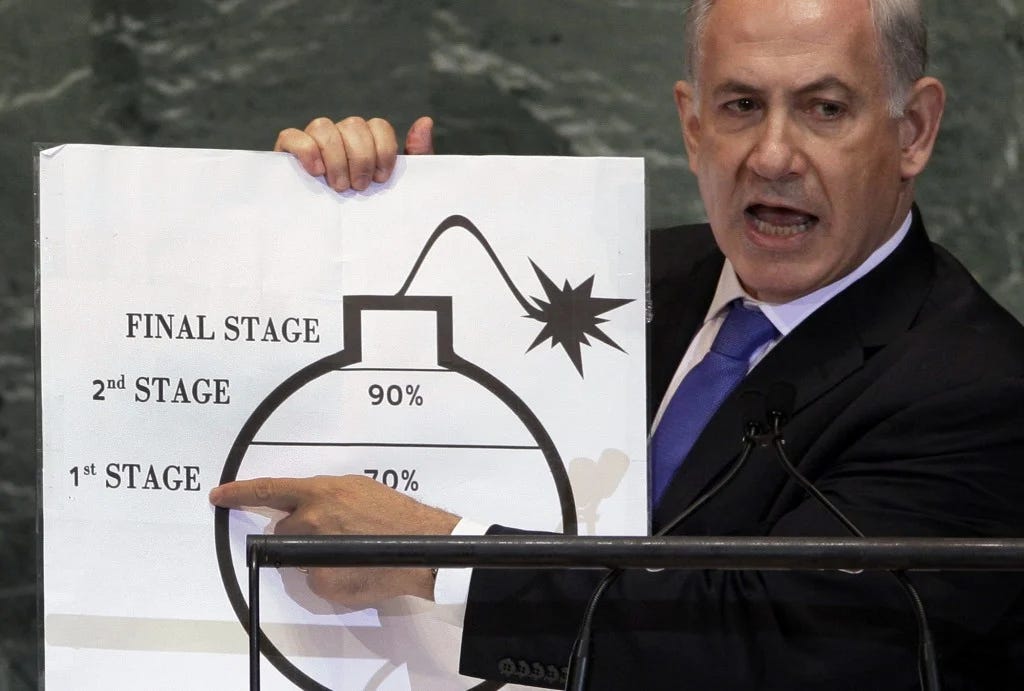
However, that middle ground was never going to satisfy or matter to Israel, and Netanyahu was able to pull the Trump administration into war anyway – first in June 2025, then again under the same pretense in February 2026. A real danger almost no one talks about is the updated incentive structure now being created: if you want a real deterrent against the U.S and Israel, you had better get a bomb, because the countries without one are the ones Washington keeps attacking.
Israel’s Real Fear Was Never a Nuclear First Strike
This gets to the part they say much more quietly. Israeli leaders themselves have admitted that the real danger was not some deranged Iranian first strike that would invite Israel’s own devastating retaliation and annihilate both countries. In 2010, Benjamin Netanyahu, despite years of warning that Iran was always just “weeks away”, and his then-defense minister and former prime minister, Ehud Barak, acknowledged that even if Iran were hypothetically to get a bomb, they did not actually fear the Ayatollah would launch a suicidal nuclear attack. What worried them instead was that it would constrain Israel’s “freedom of action” in the region against their adversaries, like Hezbollah, and even contribute to a “brain drain” of talented young Israelis leaving for the United States. Netanyahu’s predecessor, Ehud Olmert, was even more candid, telling the New York Times, “Just as Pakistan had the bomb and nothing happened, Israel could also accept and survive Iran having the bomb.”
That is a very different argument from the one sold to the American public. As former Clinton State Department official Jamie Rubin put it in Foreign Policy, Israel’s real fear was never an unprovoked Iranian nuclear strike, but losing its nuclear monopoly and, with it, the ability to use its conventional military power throughout the Middle East at will. That is the unacknowledged factor here. Iran did not even need to test a weapon to begin weakening Israeli leverage in places like Lebanon and Syria. The point was never simply stopping apocalypse; it was preserving escalation dominance.
And some of the hawks were willing to admit as much too. Danielle Pletka of the American Enterprise institute, one of the same Iraq-war crowd that helped sell Americans on Saddam’s imaginary weapons, conceded in 2011 that the problem with an Iranian bomb was not just that Iran might use it. It was that if Iran did get a bomb and then refrain from using it, it would expose just how dishonest the caricature of Iranian irrationality had always been.
So remember that now, while Washington and Tel Aviv are already at war with Iran, selling the public the same old line that tis is all about stopping some suicidal Iranian first strike. Even Israeli leaders and their allies have long made clear that the deeper fear was not annihilation, but losing the freedom to wage war and dominate the region at will to advance their “Greater Israel Project.”
The War Reveals the Lie
The war the United States and Israel launched on Iran completely blew up original justification for the 12-Day War. Even Reuters reported that the late-February U.S.-Iran talks had shown “significant progress” and were supposed to resume within days, before the war began on February 28. That matters because it makes the pattern harder to ignore: diplomacy was never the real point, and the “nuclear threat” was never the full story. As the war dragged on, even U.S. intelligence has reportedly concluded that the Iranian government is not on the verge of collapse, while the administration has given shifting and conflicting explanations for what this war is even supposed to achieve.
So the real question is the one regime-change fanatics never ask: what comes next? If you kill the old leadership, shatter negotiations, and radicalize the incentives on the other side, you should not expect a more restrained regime to emerge from the rubble. You should expect a harder, angrier, less cautious one. Mojtaba Khamenei has now taken over as Supreme Leader and is much more hardline than the previous Ayatollahs while the war has already spread across the region, with thousands dead (about a dozen Americans and counting), the Strait of Hormuz largely blocked, and attacks hitting U.S. bases and Gulf infrastructure. That is what this hostile policy towards Iran has produced; not disarmament, not peace, but a more dangerous Middle East and a stronger argument for every U.S. adversary that the only real deterrent is a nuclear one.