

My Conversation with Cliffe Knechtle
I sat down with Cliffe to discuss the Problem of Evil, the Transcendental Argument for God, and how to respond to the slavery counterargument. I was shocked by his humility and rigor.

For over forty years, Cliffe Knechtle had just been a preacher with a microphone, debating students publicly at any and every university, from Harvard to Berkeley. Over time, he has become arguably one of the faces of Christian apologetics on campus. His Christian apologetics debates, which once reached crowds of fifty students in person, now regularly rack up millions of views, without even counting short-form clips. He’s been featured on Tucker Carlson’s podcast, the Charlie Kirk Show, and the George Janko Podcast, among many others. He’s debated Alex O’Connor, Logan Paul, and more. As of early 2026, Cliffe’s ministry has exploded into a digital juggernaut, boasting over six million followers across YouTube and social media. Cliffe has moved from the campus sidewalk to the center of the global Christian conversation. Yet, despite being a viral sensation with a massive digital footprint, he still spends hours standing in the heat, sincerely listening to college students and answering the hardest questions of a skeptical generation, with his unique tone, cadence, and his trademark viral “Knetchle pose” that he does when the debate gets serious.
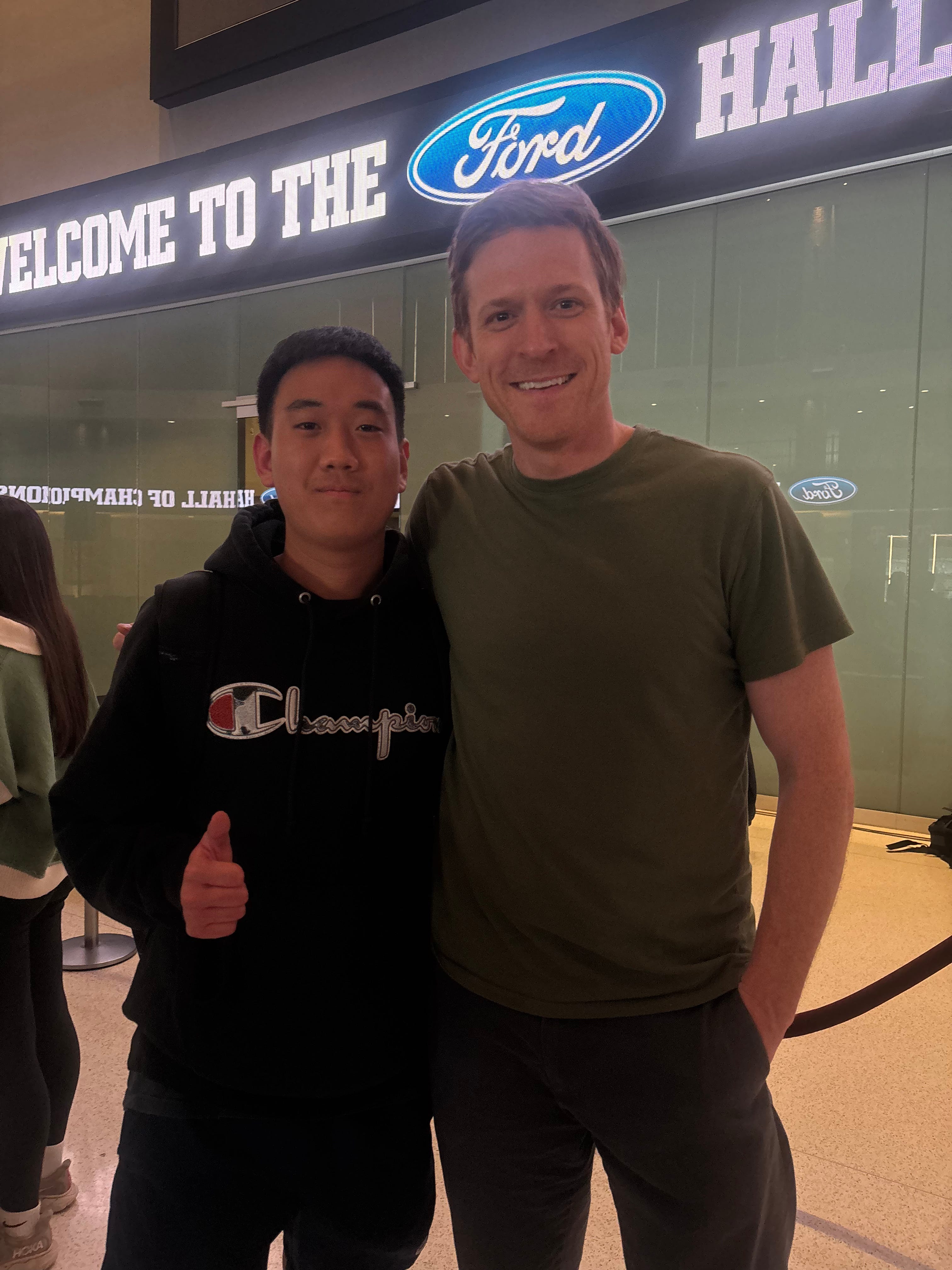
This past week, Cliffe Knechtle and his son Stuart visited Texas A&M to speak at Breakaway.
How my meeting with Cliffe happened was only by the grace of God. I was discussing with Cliffe’s wife possible alternative responses that Cliffe could’ve given in his open air dialogues. She then tells me, “You’ve got to tell Cliffe all this!” Afterwards, she sets up a time and place for us to work through common attacks against Christianity. The main purpose of our conversation was not to debate or criticize Cliffe, but to give him some extra “weapons for his arsenal,” so to speak. The main issues that we focused on were the Problem of Evil & Suffering, The Transcendental Argument for God, Slavery in the Bible, and more…
The Problem of Evil & Suffering
In our conversation, I acknowledged that I do think Cliffe handles this difficult issue well. The problem of evil & suffering attempts to create a contradiction in the premises, which typically goes:
God is all good
God is all powerful
Yet evil exists
Simply put: If an all-good and all-powerful God exists, we wouldn’t expect there to be evil and suffering in this world. What I proposed was that we need to add a 4th premise: “God has a morally sufficient reason for allowing evil & suffering that he has not revealed to us.” Now, prima facie this may seem like an unsatisfactory answer, but we must remember that the problem is an internal critique—meaning we are assuming Christianity to be true and testing its internal coherence. Therefore, when the critic attacks the Christian faith, they must also consider the 4th premise. Now that the Christian worldview is shown to be coherent, it is now up to the critic to offer a moral standard by which he accuses God of evil and suffering.
The Transcendental Argument for God (TAG)
TAG is a unique type of argument that attacks presuppositions rather than the traditional use of evidence to defend Christianity. TAG demonstrates that when an atheist/agnostic criticizes Christianity, they do so with certain assumptions or presuppositions that their worldview cannot account for. Transcendental argumentation argues that only the Christian worldview offers the necessary preconditions for knowledge—some examples I gave Cliffe were laws of logic, identity over time, and uniformity in nature. Very briefly put, these are the issues that the atheist/agnostic faces:
Laws of Logic—Can laws of logic change? Can contradictions be allowed in the next couple minutes? Do laws of logic exist in space/time or are they immaterial? How do we ground an immaterial, invariant law in a constantly changing universe?
Identity over time—If all that exists is the material world, then a person is defined by the molecules that make them up. If what defines us are our molecules, aren’t you a different person than you were 5 minutes ago because you’re now a new set of molecules? The problem of identity over time poses a threat to ethics. If a prisoner is not the same person as the one who committed the crime, what reason do we have for keeping him in prison?
Uniformity in nature—In a world of random chance, what basis do you have in believing that the laws of gravity will continue to hold? Why are laws of physics consistent?
Slavery in the Bible
Another difficult issue that Christians often face is that God allegedly permits or even endorses slavery in the Bible. Again, I believe Cliffe has a great response to the issue, which essentially says that God was “tightening the noose” on slavery—in other words, God was slowly reforming the slave culture of the time. My only suggestion was that Cliffe use a concrete example, like that of an addicted smoker, to make the concept easier to grasp. In the case of the smoker, say he goes through 20 cigarettes a day. We don’t expect him to completely give up all 20 at once. We may begin by reducing it to 15, then 10, then 5 and so on. God operated in a similar fashion when dealing with a culture that was rampant with slavery.
Conclusion
It honestly pains me that Cliffe has lately received so much criticism. He is literally one of the most humble people I’ve ever met. I mentioned in the video how backwards it felt that he was taking notes of what I was saying… It should’ve been the other way around! Despite his busy schedule, Cliffe sat down with a college student and attentively listened and took notes for 45 minutes. This is not a man who is full of himself; he is a man who genuinely loves God and loves people.


 | A guest post by
|