

Is Deflation Actually Bad?
Deflation has been sold as some kind of economic catastrophe, when it’s really just what happens in a free market when productivity rises and money isn’t being manipulated.

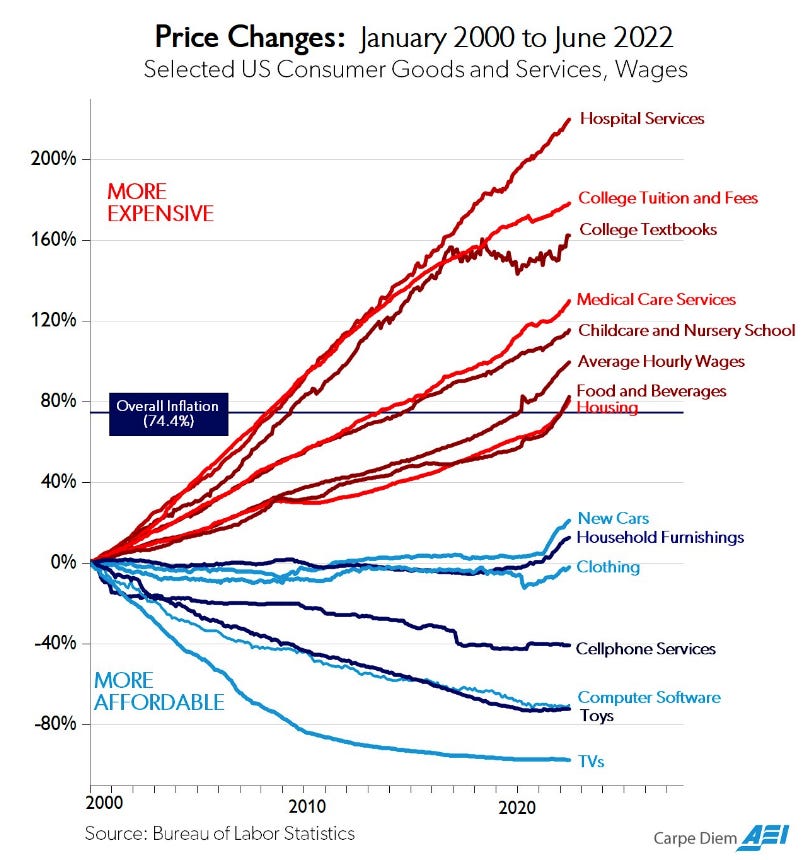
Why are people scared of deflation?
Many critics of a deflationary economy argue that in a deflationary environment, nobody buys anything and people “hoard” their money. If you knew you could buy a car next month for 30% less, why would you buy it now? Why would you buy anything at all in fact? You would just sit on your money and not engage in the economy, right? They argue that if things aren’t always increasing in price, no one is ever incentivized to do anything today, and the economy grinds to a halt. Now these points may seem to make sense at first, but the moment you actually think about it, the argument falls apart.
If someone is going to make the claim that in a deflationary environment, no one ever buys anything, they’re not just speaking in abstractions–there have been deflationary environments before, even in the United States. Is it true that during these times, no one ever bought anything? Of course not. This is just an odd excuse to defend the Federal Reserve and the inflationary economy, which is a completely government-created phenomenon.
Time Preference
First, for the question “Why would anyone buy anything if we lived in a deflationary economy?” The obvious answer here is time preference–how much people prefer present things to future things. For example, “Why would you buy a car now if a car is going to be cheaper in a month from now?” The answer to that is you need one this month! Of course, I am not arguing that no purchasing patterns would be altered by things going down in price, but we can all think of examples of things that people still need and aren’t able to postpone purchase for.
Take electronics for example. To get a big, flat-screen TV 15 years ago cost maybe $4,000 and was a heavy lift and a pain to move around. Today, you can get a flat-screen TV that you can carry out of the store in one hand for like $300. The quality is way up and the price is way down.
And as we all know, over the last 15 years, nobody bought TVs because the price was going down, right? Why would you buy a TV when they’re just going to be cheaper and better in a few years? Well because maybe you want to watch something between now and then! If you knew groceries were going to be down 30% next year, why would you buy groceries this year? Because eating this year means something to you too! You care about the time when you receive the goods you want to buy. This is exactly what time preference means and why it’s important in economics.
Inflation eventually catches up
Now, imagine you had a car that was well-functioning and you wanted to get a brand new car, and then you found out that they’re slashing prices next year. That might encourage you to wait a little bit longer on that purchase. But the same is true in reverse! That if the price of the car is going up, you might buy it earlier than you otherwise would have, which may not be the best thing for you at that moment. Obviously, anticipating a price being lowered or a price being raised could change your consumption behavior in one way or the other. If you were in the position of “I am not going to get a new car this year because I can get one next year for even cheaper, or an even nicer car next year, so I am going to wait,” why is that worse than “I don’t really need a new car but I am going to buy one now because this is the last time I am ever going to be able to afford one?” Isn’t it obvious that the latter is a bigger problem? Inflation catches up to present consumption eventually. Again, inflation incentivizes present consumption, whereas deflation incentivizes saving and more long-term thinking. If you want to argue against that, good luck.
Deflation is objectively a good thing.
Maybe not a massive amount all at once or you might have a steep recession, but in terms of “should we be targeting 2% inflation” versus “should we be targeting 2% deflation,” in one scenario, things get more and more affordable, in the other scenario, they get more and more expensive. This is how we’ve come to find ourselves in an “unaffordability crisis.” Which do you think is better for poor people? If things get more expensive or if things get cheaper?
Behavioral effect and time horizons
Deflation means people delay gratification and choose to save instead, which means they can make bigger, more important purchases later because they’ve actually built up their balances. And on a more behavioral level, if you know your money will be worth more in the future, you get a healthier mindset–people won’t feel pressured to think “my wealth is being stolen from me so I need to spend it now before it’s worth less.” Instead, they start thinking, “I want to buy a house someday, so I’ll save. Maybe I won’t go out and drink this weekend, it’s not worth blowing extra bucks at the bar if I can buy a car later this year when cars are cheaper.” So all of a sudden, you’ve got people thinking on longer time horizons, forward-looking, planning their lives, their savings, and their future investments rather than just making impulsive decisions.
Inflation rewards debt and punishes saving
Now, we’ve got an economy where the message is basically, “we need people to go out and spend.” This is a short-sighted mindset; spend everything now, borrow against future earnings, and keep everyone in debt. That’s the pathology that comes with overinflated prices; where we’re always trying to pull more money in to keep the wars going, the bubbles afloat, and the illusion that we’re richer than we actually are. Who can honestly look at the American economy and say the problem is too much saving? That “everyone is saving too much, there isn’t enough spending, consumption, or debt? Everybody is just at a surplus here?” In what world is that a problem? George W. Bush may have been the one who explicitly said, “go shopping” as the answer to the early 2000s recession, but the policy instinct has been the same ever since: inflate, stimulate, and keep spending up; under Trump and Obama with the stimulus and Fed money-printing, and under Biden with the Covid spending response. And now, Trump’s pressuring the Fed to cut rates, doubling down on cheap credit, trying to outrun the bust.
Deflation is the market, and inflation is the government
What this all becomes is an excuse to keep the inflationary economy going. Sure, most critics don’t want Biden’s 17% inflation, they just want the Fed to hit its 2% target: 2% of your wealth being quietly stolen every year (keep in mind it compounds). But the deeper problem is that it’s a fatal conceit. The moment you concede that deflation is bad and inflation is good, you’ve basically conceded the whole framework and you’re most of the way to socialism. Because deflation is really just the market, and inflation is really just the government. In an advancing economy, mild deflation is the status quo as progress raises efficiency and quality. So this whole argument is really a defense of today’s status quo, which is a system where the elites, if left unchecked, rob from the little guy.
How about this: I work hard, make money, and keep the money without it being worth less in the future?
 | A guest post by
|