

Iran: What Happened to No More Wars?
Opinion: The massive military buildup against Iran serves foreign interests, threatens global stability, and strays from Trump's previous promises.

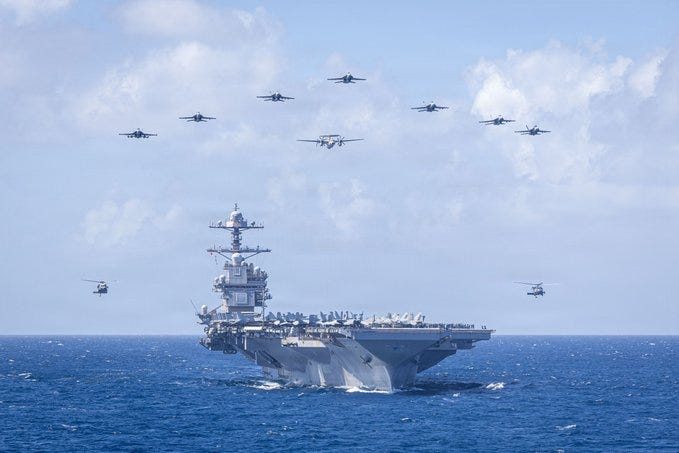
USS Gerald R. Ford on the Caribbean (U.S Navy)
Opinion: The views expressed in this article are the author’s and are published as commentary and analysis by The Aggie Standard. Responses and fruitful dialogue are welcome.
Yesterday morning, the USS Gerald R. Ford entered the Mediterranean. The largest aircraft carrier ever built, carrying upwards of 70 aircraft and enough firepower to rearrange a country’s geography, is now pointed somewhere between Israel and the Gulf of Oman. In the past 64 hours, 48 F-16s, 12 F-22 Raptors, 18 F-35As, surveillance aircraft, and over 40 aerial refueling tankers have been repositioned to bases across the Middle East and Europe. THAAD and Patriot missile defense batteries have been quietly redeployed. The USS Abraham Lincoln is already in the Arabian Sea. There has not been this kind of American military concentration in this region since the opening salvos of Operation Iraqi Freedom in 2003. This would be a devastating military campaign serving interests other than our own.
On February 17th, American and Iranian negotiators sat across from each other in Geneva for the second round of nuclear talks in less than a week. Both sides called it productive. Iran signaled it was willing to pause enrichment for two to three years and give up roughly a third of its highly enriched uranium stockpile in exchange for sanctions relief. A framework, cautiously, seemed to be forming. And then, before the delegations had even made it home, Vice President Vance stepped in front of cameras and gave Iran two weeks to meet American demands or face consequences. Iran responded by closing part of the Strait of Hormuz for war games and filing a NOTAM for ballistic missile tests over the Gulf of Oman. That is the state of diplomacy as of today. Signs are pointing towards war.
What Iran Will and Won’t Give
Iran’s position has been consistent throughout these talks: nuclear program and sanctions relief are on the table. Its ballistic missile program and its regional proxy network, the Houthis, Hezbollah, militias in Iraq, Hamas, are not. Tel Aviv wants all of it, Washington has been willing to settle. Iran has said no and has not wavered.
This is being reported as Iranian stubbornness. It might be more accurately described as rational self-preservation. Eight months ago, in the middle of the last round of negotiations, Israel launched preemptive strikes which lasted close to two weeks and ended with, B-2 stealth bombers striking nuclear sites, Fordow and Natanz. Along with American submarines launching Tomahawk cruise missiles at Isfahan. Washington declared Iran’s nuclear program destroyed. Tehran said otherwise. The truth is probably somewhere between those two claims, significant to moderate damage, not total elimination, which is precisely why we are sitting at another negotiating table right now, with two carrier strike groups in the water.
For a country that was bombed while talks were ongoing, the insistence on keeping its missiles and its regional leverage is not obstinance. It is the only deterrent Iran has left. The nuclear hedge program follows the same logic, and it is the same logic, incidentally, that explains why North Korea still has a government and Muammar Gaddafi does not. Iran looked at that history and drew the obvious conclusion.
Whose War Is This, Exactly?
Here is a fact worth sitting with: every country in the region with real skin in the game, Turkey, Egypt, Saudi Arabia, Qatar, Oman, Iraq, is pushing hard for a negotiated settlement. The economic consequences of a war, the energy market shock of a closed Strait of Hormuz, the refugee flows, the regional spillover, none of these countries want any part of it. The United States says it prefers a deal. Iran, within clear limits, appears willing to discuss one.
And yet the demands currently on the table are structured in a way that makes a deal functionally impossible. Full nuclear dismantlement. Complete abandonment of all proxy groups. Elimination of the ballistic missile program. These are not negotiating positions, they are terms of unconditional surrender. No Iranian government, hardline or moderate, could accept them and remain in power for a week. The question worth asking is: where did those demands come from, and whose interests do they actually serve?
The answer is not difficult to find. Israel’s objective has never been a nuclear agreement. Netanyahu has made that clear. The goal is the permanent elimination of Iran as a regional power, regime change dressed up in the language of nonproliferation. That is a coherent Israeli strategic interest. What it is not, when examined honestly, is an American one.
Last June, while negotiations were still active, Israel struck Iran, triggering the Twelve-Day War and pulling the United States into direct military action it had not planned to take at that moment. The pattern is now well established: Israel escalates past the point diplomacy can hold, and America is left holding the consequences. The casualties would be American. The bill would be American. The decade of entanglement that follows would be American. The strategic benefit, a neutered Iran, a cleared regional chessboard, and total hegemony of one of the most resource rich region in the world, would be Israel’s. At some point, Washington must decide whether it is conducting American foreign policy or Israel’s.
Iran Is Not Iraq
There is a comfortable fantasy in some corners of Washington that Iran can be bombed into submission, that a sustained air campaign breaks the regime, the population rises, and the Islamic Republic collapses into something more manageable.
Iran is a country of 90 million people. Its missile stockpile exceeds 3,000 weapons, with an estimated 300 produced every month. During the Twelve-Day War, Iranian salvos came close to exhausting Israel’s interceptor supply, and Israel is one of the most missile-defended countries on earth. Iran possesses long-range ballistic missiles capable of reaching Europe and, by multiple assessments, hypersonic weapons as well. Its combined military force approaches a million. Its facilities are hardened and buried into underground missile cities. It is not Syria. It is not Saddam Hussein’s Iraq. It is not Venezuela, where a single night’s operation ended everything.
Airstrikes can damage Iran’s nuclear infrastructure. They demonstrated that last June. What they cannot do is produce regime change, and regime change, if we are being honest about what Israel is asking for, is the actual end goal. Achieving that would require a ground invasion of a mountainous, nationalistic, heavily armed country exceeding any power we have seen in that region before. This would be a devastating military campaign serving foreign interest.
And before the first bomb drops, Iran could mine or block the Strait of Hormuz, the narrow passage through which 31% of the world’s seaborne crude oil moved in 2025. The global economic consequences of that alone would be severe. A war with Iran does not stay contained to Iran. It never would.
Two Weeks to Get It Right
The ultimatum expires in two weeks. Iran will submit written proposals. A third round of talks is tentatively on the calendar, although chances are this will not happen with the intensifying military buildup in the Middle East. Whether the gap between what Washington demands and what Tehran can politically survive is bridgeable in that window is close to zero. The structural conditions that produced the Twelve-Day War, stalled talks, hardening positions, Israeli pressure for outcomes that preclude any deal, American military assets accumulating in theater, are all present again, in the same configuration.
A realistic agreement exists. A credible enrichment cap, real verification mechanisms, phased sanctions relief, something that neither side loves but both sides can live with. That deal would serve American interests. It would not satisfy Israel’s objectives at all, which is perhaps the most telling thing about why it hasn’t happened yet. Israel does not want a deal. It has never wanted a deal. What it wants is an end of the Islamic Republic, full regime change. And for the better part of a year, Israeli pressure has shaped American foreign policy and negotiating positions to make a deal structurally impossible.
Whatever happened to “no new wars”? It was supposed to distinguish a new American posture from two decades of endless entanglement, bloodshed, and borrowed money, a promise that this country had spent enough rearranging the Middle East and had nothing to show for it. And yet here we are again, carriers in the water and jets in the air. Twenty years of Middle Eastern intervention and the only winner has been Israel. It is time America takes back its foreign policy and starts fighting for American interests.
The United States does not need another open-ended war in the Middle East. The defining strategic competition of this era is in the Pacific, with China, over Taiwan, over trade and technology and the balance of power in Asia. Every carrier, every F-22, every diplomatic hour spent managing an Iranian conflict is a resource diverted from the place that actually determines America’s future.
 | A guest post by
|