

If God Doesn’t Exist, Murder Isn’t Wrong
Without a Creator, "good" and "evil" are just personal opinions, like your favorite ice cream flavor. Here is the logical proof why objective morality requires God.

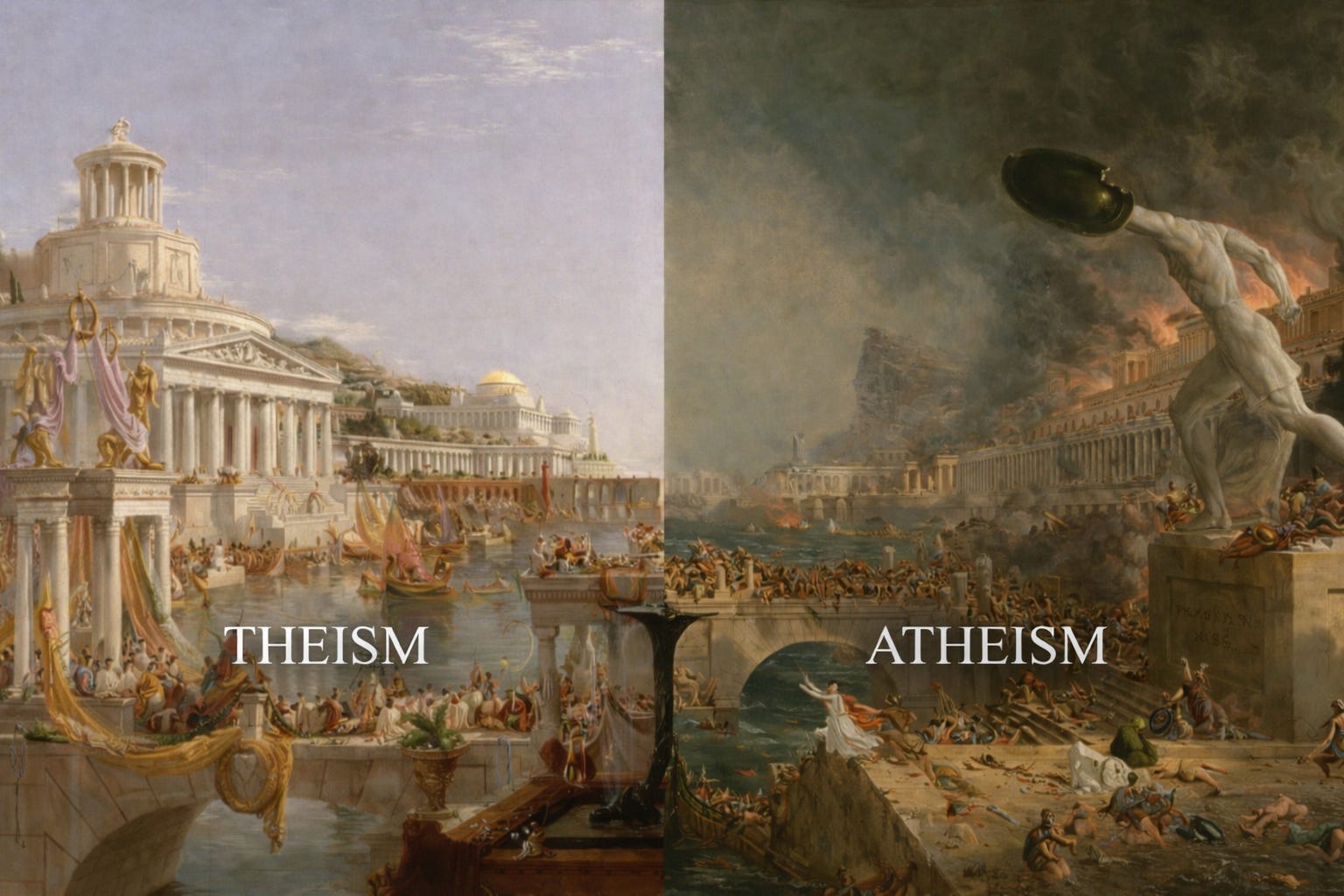
Thomas Cole (1801–1848). The Consummation of Empire (left) and Destruction (right), oil on canvas. Text added.
One of the strongest proofs for the existence of God is found in the human conscience. It is called:
The Moral argument
If God does not exist, objective moral values do not exist.
Objective moral values do exist (e.g., rape, murder, and genocide are objectively wrong).
Therefore, God exists.
Preference vs. fact
The first premise is often misinterpreted. By “objective moral values,” we simply mean “mind-independent”. Regardless of what I think in my mind, the reality is that I am typing this on a computer. That is an objective fact.
The opposite of objective is subjective: a personal preference. For example, whether pineapple on pizza is better than pepperoni, or whether chocolate ice cream is better than vanilla. Neither of us is “wrong” if we disagree; we just have different tastes.
Here is the uncomfortable truth that secular society tries to ignore: If God does not exist, moral judgments are nothing more than subjective preferences like pineapple on pizza.
If we are nothing more than the accidental byproduct of a cosmic fart, if we are just biological matter that evolved from slime, then saying “murder is wrong” is simply a personal taste. Biology does not determine morality. A lion is not “evil” for killing a gazelle; it is just surviving. If we are just advanced animals, why is it “evil” for a human to kill another human?
Without God, there is no objective standard upon which moral judgments can be grounded. As the famous author Fyodor Dostoevsky put it:
“If there is no immortality, then all things are permitted”.
The “harm” and “human flourishing” counterarguments
Many naturalists and atheists try to avoid this conclusion by pivoting to “harm,” arguing that anything causing physical or mental harm is wrong, or citing “human flourishing” as the source of morality. This perspective sounds solid at first, but it collapses in the real world.
First, physical harm isn’t always “wrong.” Consider the difference between a surgeon and a mugger. Both might cut you open with a knife and cause massive trauma. Why is one “healing” and the other “evil”? It comes down to intent and consent. Or look at boxing: two men beat each other into concussions for money, yet we call it a sport, not a crime. If you pull your child’s ear after he seriously disobeys you, that’s causing suffering, but it’s not wrong. Physical harm alone is not the standard. You need a higher moral framework (which naturalism cannot provide) to tell you which physical harm is “suffering” (bad) and which is “justice” or “medicine” (good).
Second, who gets to decide what is “harm” or “human flourishing”? Leaving it up to societal consensus, to mob rule, is terrifying. To quote Ben Franklin, it’d be like letting “two wolves and a lamb vote on what is for dinner”. In the Jim Crow South, they decided that segregation wasn’t “harm,” but the natural order. Because that society agreed on it, by the naturalist definition, they weren’t strictly immoral. The same goes for the dehumanizing propaganda in Nazi Germany; their society decided that viewing Jews as a “disease” was necessary for national health.
Adolf Hitler, Joseph Stalin, Mao Zedong, and Fidel Castro all believed they were working for “human flourishing”. They thought that the way to help humanity prosper was to eliminate specific groups of people: Jews, political dissidents, or the wealthy. In the 20th century alone, this logic led to the deaths of 80–100 million people. When Che Guevara killed homosexuals in his concentration camps, that was his understanding of “human flourishing”.
If God does not exist, who are you to say they were wrong? You can say their actions were “unpleasant.” You can say you “don’t like it.” You can say they “caused suffering”. But that’s not enough. But if there is no higher authority than man, then Hitler was just “living his truth” and doing what he thought was best for his tribe. Without God, his actions were no different than a chimpanzee killing a rival primate. It’s your word against his.
The “is-ought” problem
This brings us to the biggest philosophical problem in naturalism. Science and biology can tell you what the world is like, but they cannot tell you what it ought to be like. There is a gap between those two things that logic alone cannot bridge.
The “Is” (scientific fact): “If you stab a man in the chest, he will die.”
The “Ought” (moral claim): “Therefore, you ought not stab a man.”
The conclusion doesn’t actually follow from the premise. The fact that he will die is just a biological description. To get to “you shouldn’t do it,” you have to smuggle in a hidden value judgment: “And human life ought to be preserved.” But a naturalistic worldview cannot prove that hidden premise. It can explain how a human dies, but it cannot explain why murder is objectively wrong.
Evolution gave us lots of impulses. We have a natural impulse to avoid suffering, sure, but we also have natural impulses for tribalism, aggression, and sexual promiscuity. All of these behaviors historically helped ancestors pass on their genes, prevented suffering in one way or another, and even caused our flourishing.
The point is, if you rely purely on “what nature gave us,” you have no way to pick and choose which of these instincts we ought to follow. Why is the instinct to “care for the tribe” good, but the instinct to “crush the rival tribe” bad? They are both natural.
The inescapable conclusion
This leads us to the second premise: Objective moral values do exist.
We all know deep down that the Holocaust was not just “unfashionable” or “evolutionarily disadvantageous.” It was evil. It was a moral abomination that violated the sanctity of human life.
When you see an injustice and feel that righteous anger, when you scream that something should not be, you are admitting that there is an objective standard of Right and Wrong that transcends human opinion. You are admitting that “Good” is a real thing, not just a social construct.
And if objective Good exists, there must be a source of that Good.
We are not the products of blind chance, forced to build our lives on a “foundation of unyielding despair,” as the atheist Bertrand Russell believed. On the contrary, the existence of our conscience proves that we are the sons and daughters of the Most High. We have been given free will so that we might choose to do what is good.
So, the next time someone tells you that morality is just a social construct, ask them if they believe murder is really wrong, or if they just “don’t prefer it.” Their answer will lead them directly to God.
Objective moral values exist. Therefore, God exists. It is as simple as one plus one equals two.
Justino Russell,
Student, Founder, Editor
The Aggie Standard